guide · quality · consumer
How to recognise authentic extra virgin olive oil: 7 signals on the bottle
Seven practical signals — from the label to the price to the taste — to recognise authentic extra virgin olive oil and stop being fooled at the supermarket.
The extra virgin olive oil market is one of the most mystified in the food sector. Independent studies on commercial oils sold in supermarkets have found significant percentages of products that, although labelled "extra virgin", do not meet the quality parameters of the specification. The good news is that you don't need to be a certified taster to avoid the worst traps: seven quick checks, doable in thirty seconds at the shelf, are enough.
1. Origin must be precise, not vague
Beware of: "extra virgin olive oil from EU countries", "blend of extra virgin oils from the Community", "100% Italian" with no other indication.
Look for: "100% Italian olives harvested and milled in [region/town]", "DOP/IGP [specific area]", indication of the mill where extraction took place.
Generic origin is almost always the signal of an industrial blend: oils of dubious provenance (Spain, Tunisia, Greece during overproduction periods) bottled in Italy. Legally it's "Italian oil" if bottled in Italy. Technically it's something else entirely.
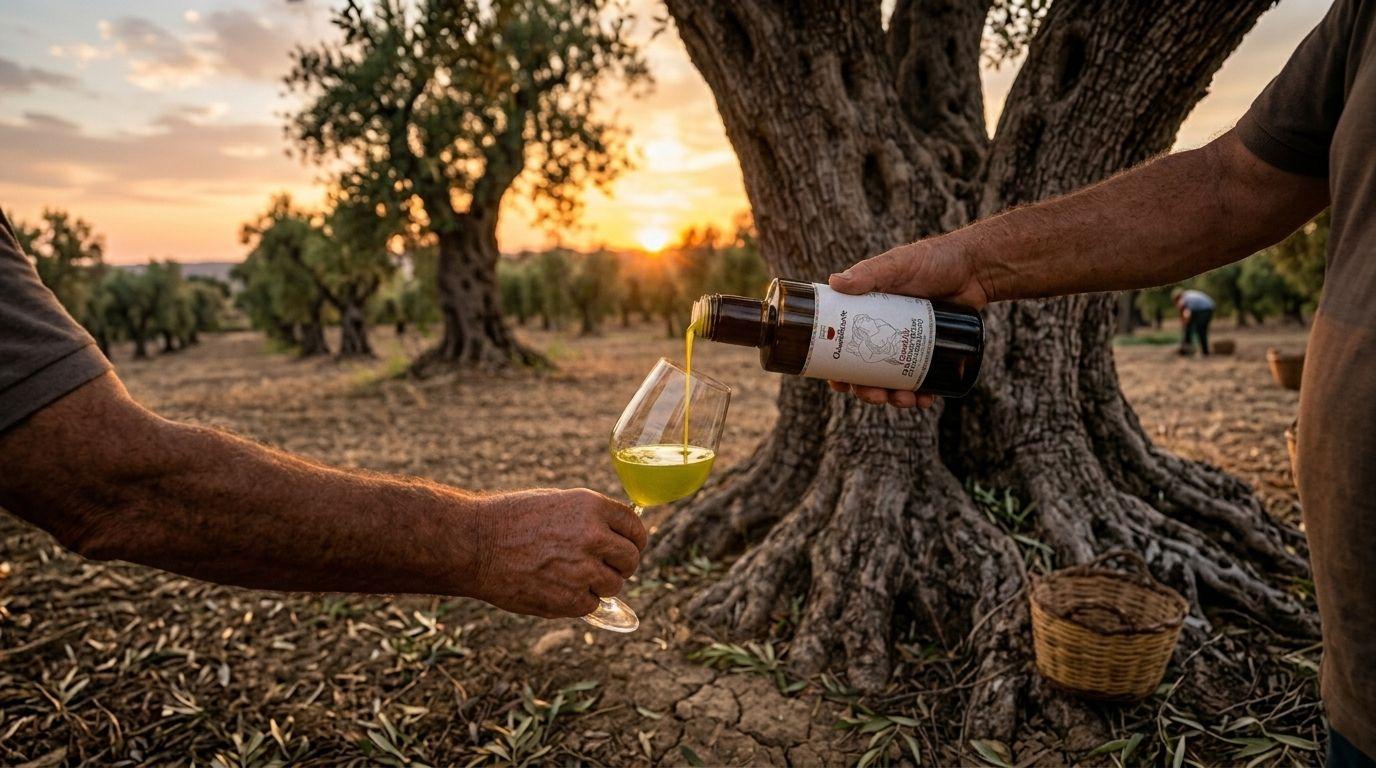
2. Dark bottle, always
EVO oil oxidises with light. A clear bottle left on a supermarket shelf under fluorescent lights loses its polyphenols and aroma in weeks.
Look for: dark glass (dark green, brown) or opaque tin. Clear bottles, even if they contain good oil, are already a signal of low producer attention — or marketing that puts aesthetics before quality.
3. Harvest date, not just bottling date
Beware of: only "best before" or "expiration date". A producer can bottle today an oil harvested two years ago and put a 2027 expiration on it.
Look for: "harvest year" or "olive campaign [year/year]" (e.g. 2025/26 = olives harvested between October 2025 and January 2026). A fresh oil should be consumed within 12–18 months from harvest. Beyond that, aroma and organoleptic properties fade progressively.
4. Free acidity declared
The European specification permits up to 0.8% acidity to call an oil "extra virgin". It's a high limit: serious producers stay well below.
Look for on the label or technical sheet:
- Below 0.3%: excellent
- 0.3% – 0.5%: good
- 0.5% – 0.8%: legal limit, marginal quality
A producer who declares acidity on the label has something to show. One who doesn't probably doesn't want to.
5. The price can't be too low
Real extra virgin oil has structural production costs. The average yield in Sicily is about 15–18 kg of oil per quintal of olives (the Italian national average is even lower). A century-old olive tree produces 30–50% less than a modern commercial variety. Hand-harvest or comb-harvest costs 4–6 times more than mechanical harvest.
Threshold for serious Italian oil (500ml):
- Below €8/litre: unlikely to be true Italian EVO
- €8–12/litre: borderline, uncertain quality
- €12–25/litre: "good authentic EVO" range
- €25–50/litre: premium monocultivar, DOP, certified organic
An oil sold at €4/litre is mathematically impossible as true Italian EVO: harvest and milling costs alone exceed that price. You're either buying a low-quality Mediterranean oil or a "lampante" oil chemically refined.
6. Colour doesn't matter. Smell and taste do.
Myth to debunk: "green = high quality". False. The colour of the oil depends on the cultivar and the moment of harvest — it can be golden green, full gold, amber, and any of these can be excellent.
What really matters at opening:
- Smell: fruity fresh olive, leaf, cut grass, tomato, almond, artichoke. Never rancid, mouldy, winey, earthy, "old oil".
- Taste: bitter and pungent (more or less marked depending on the cultivar) are quality signals, not defects. The tickle in the throat = active polyphenols = active antioxidants.
- Typical defects: rancid (smells of old nuts), fusty (fermented oil), muddy sediment. If you sense one, return or discard.
7. Storage that the point of sale respects
Even an oil born excellent can deteriorate at the supermarket:
- Shelf near bread ovens, lights, sunny windows: temperature above 22–24°C accelerates oxidation
- Bottle standing in direct light: even with dark glass, prolonged exposure damages the product
- Box opened for weeks: prolonged exposure to warehouse heat is invisible but destructive
Prefer: specialist wine shops, temperature-controlled delicatessens, direct purchase from the producer or short-supply-chain e-commerce where you know the oil hasn't sat for six months on a pallet.
The three safety cuts
Summing up the seven rules into three quick actions when you're at the shelf:
- Look at the bottle: dark, detailed label, harvest year present?
- Calculate price per litre: below €8/L is almost always an illusion.
- Ask who made it: if the label doesn't answer with a name, a place and a precise harvest year, walk away.
Three minutes that separate you from a litre of low-pedigree "extra virgin" oil and from a real EVO worth every cent.
Skipping luck altogether
The other path — more reliable in the long run — is building a network of trusted producers to come back to. A small mill, a Sicilian farm estate, an oil cellar to order the new harvest from each year: once found, the problem is solved forever. It's what our grandparents did when they went directly "to the oil mill" before winter. Today you do it with two clicks — but the logic is the same.
Our extra virgin organic DOP olive oil is sold directly via the online shop. Every bottle states harvest year, cultivar, free acidity and lot number. Shipping across Italy and Europe directly from Tenuta Chiaramonte in the province of Ragusa.